










Presentation at the International Energy and Environment Conference 2025
We were delighted to present at IEEC 2025 in Ostravice, Czech Republic. The conference brought together a vibrant community of researchers and practitioners, with a scientific
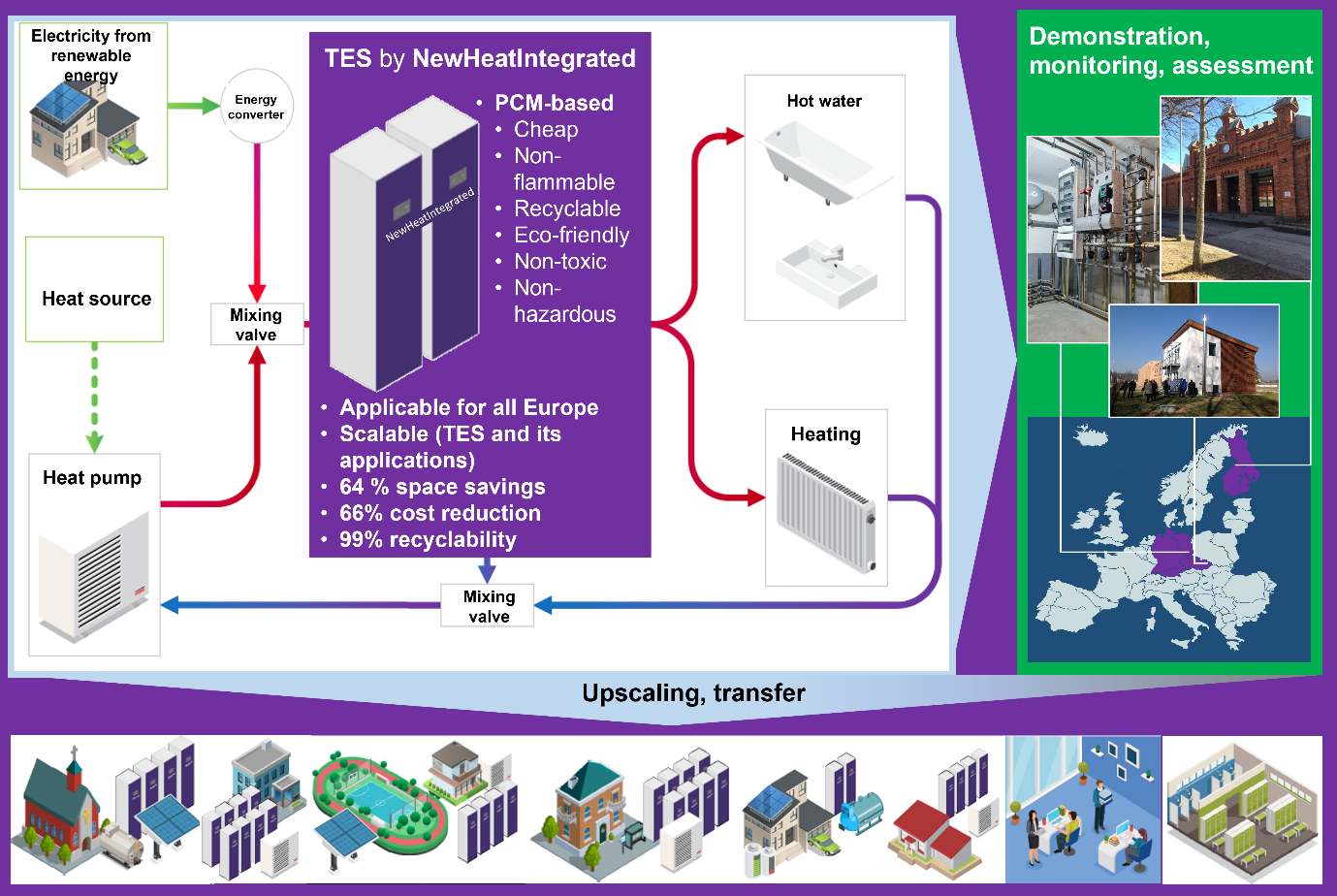
The overall system is based on a modular system of high-performance TES combined with state-of-the-art sensor technology. The second focus of NewHeatIntegrated is the networking of this TES system with the local energy infrastructure to form an orchestrated overall system, so that all local energy sources and sinks are intelligently linked to form a holistic solution. The proof of concept and its quantified underpinning with real measurement data from the demonstration sites, various application scenarios and simulations represent the third component of the project. This comprehensive system demonstration serves not only to verify and evaluate the development goals, but also to effectively communicate and raise awareness of the potential of innovative and individualized energy systems in the private, public and commercial contexts of society.
The TES to be developed is based on two separately switchable latent heat thermal energy storage stages (sLHTES), which are filled with different switchable phase change materials (sPCM). The operating temperatures of the storage modules are optimally matched to the typical flow temperatures of 35 °C and 55 °C in (residential) buildings with heat pumps and panel heating systems1,2,3, which significantly improves the exergetic efficiency of the overall system on the one hand and the annual coefficient of performance of the heat pump on the other. Furthermore, compared to the current state of the art, a significant increase in storage density (space saving of up to 64%4) is achieved with higher economic efficiency (up to 60% cost reduction calculated over the first 5 years5) and assured sustainability (virtually complete recyclability of the entire TES6).
Due to the switchability and modular structure of the TES system developed in NewHeatIntegrated, it plays a key role in energy and cost-optimized operation when integrated into the planning or existing energy system. The prerequisite for this is an intelligent integrated control unit that is able to record all energy flows in the building complex and also incorporate external site influences, such as energy prices and weather data, into the operating strategy. NewHeatIntegrated will develop and provide a corresponding system control.
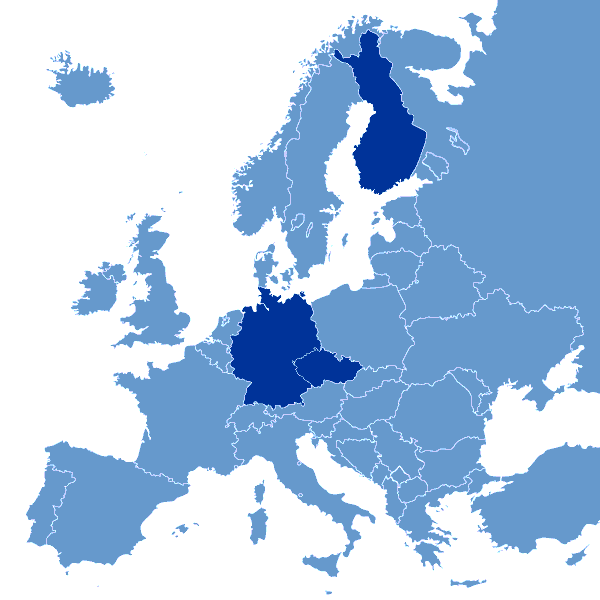
The demonstration plants and buildings located in Finland, Germany and the Czech Republic all have a technical infrastructure that enables the integration of new/additional TES. In addition, data acquisition systems and long-term recordings of all relevant energy consumption parameters are already in place at these sites.
In concrete terms, the aim of NewHeatIntegrated is to transfer the individual system components from the current state of development (TRL 4-6) to three sLHTES demonstration systems in a real operating environment (TRL 7).
1 Corresponding heating systems are becoming increasingly important in modern, modernized and future building stock due to their introduction, which is required and subsidized by the state, especially in Germany. [1].
2 The flow temperature for fresh water is between 50 °C and 60 °C due to the requirements for reducing the risk of legionella [2].
3 The usual flow temperature for space heating in panel heating systems is approx. 35 °C [3],[4].
4 Compared to a water-filled stratified storage tank with a specific heat capacity of ~4200 kJ/(m³*K) and a typical usable temperature spread of 20 K to the domestic hot water and 40 K to the heating circuit
5 sLHTES with 260 kg sPCM and stratified buffer cylinder with a capacity of 500 l; comparable purchase price of € 4000; average daily electricity savings for cylinder loading of 3.6 kWh or cost savings of € 520 per year. Calculation basis: (doubling of the JAZ by lowering the flow temperature for the room heating from 65 °C to 35 °C [3]; electricity price of 40 ct/kWh; heating requirement of 55 kWH/(m²*a) (corresponding to KfW85 standard) with 110 m² living space.
6 The sLHTES for a detached house consists of around 58 % by weight PCM (100 % recyclable), 38 % by weight aluminum and steel alloys (heat exchangers and tanks; 100 % recyclable) and 2 % by weight each of insulation and control components (over 60 % recyclable).
[1] Bundesministerium für Wirtschaft und Klima und weitere Unterzeichnende. Gemeinsame Absichtserklärung Mehr Tempo bei der Transformation der Wärmeversorgung: Wir brauchen schneller mehr Wärmepumpen, 2022.
[2] Deutsche Verein des Gas- und Wasserfaches e.V. Trinkwassererwärmungs- und Trinkwasserleitungsanlagen – Technische Maßnahmen zur Verminderung des Legionellenwachstums: Planung, Errichtung, Betrieb und Sanierung von Trinkwasser-Installationen; Beuth Verlag GmbH, 2004 (DVGW W 551:2004-04).
[3] Günther, D.; Wapler, J.; Langner, R.; Helmling, S.; Miara, M.; Fischer, D.; Zimmermann, D.; Wolf, T.; Wille-Hausman, B. WPsmart IM BESTAND: Felduntersuchung optimal abgestimmter Wärmepumpenheizungssysteme in Bestandsgebäuden beim Betrieb im konventionellen sowie im intelligenten Stromnetz (Smart Grid), Freiburg, 2020. Available online: https://www.ise.fraunhofer.de/content/dam/ise/de/downloads/pdf/Forschungsprojekte/BMWi-03ET1272A-WPsmart_im_Bestand-Schlussbericht.pdf (accessed on 21 March 2023).
[4] Vaillant Deutschland GmbH & Co. KG. Vorlauftemperatur: Fußbodenheizung & Heizanlage richtig einstellen. Available online: https://www.vaillant.de/heizung/heizung-verstehen/tipps-rund-um-ihre-heizung/vorlauf-rucklauftemperatur/ (accessed on 21 March 2023).
We were delighted to present at IEEC 2025 in Ostravice, Czech Republic. The conference brought together a vibrant community of researchers and practitioners, with a scientific

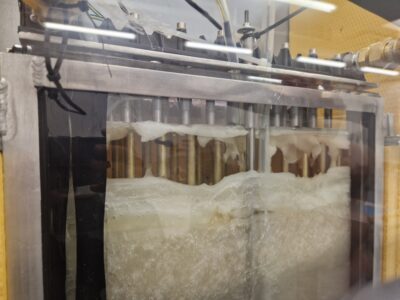
The development of a prototype Phase Change Material (PCM) storage tank necessitated the implementation of a comprehensive temperature monitoring system to ensure precise spatial temperature measurement across different sections of the tank. To achieve this, a distributed temperature sensing network was designed using Dallas DS18B20 digital temperature sensors, selected for their compatibility with OneWire communication and ease of serial installation.

Another outcome of the collaboration between VSB-TUO and the Fraunhofer-Gesellschaft is the NewHeatIntegrated project. This initiative focuses on advancements in thermal energy storage and involves a collaboration between experts from Fraunhofer ICT, Fraunhofer IWU, the University of Vaasa, BME, nollaE Oy, the Faculty of Electrical Engineering and Computer Science (FEECS), and the Faculty of Civil Engineering at VSB-TUO. In an interview, Jiří Koziorek, Head of the Department of Cybernetics and Biomedical Engineering at FEECS, reveals how this collaboration came about and what they aim to achieve with this project.