
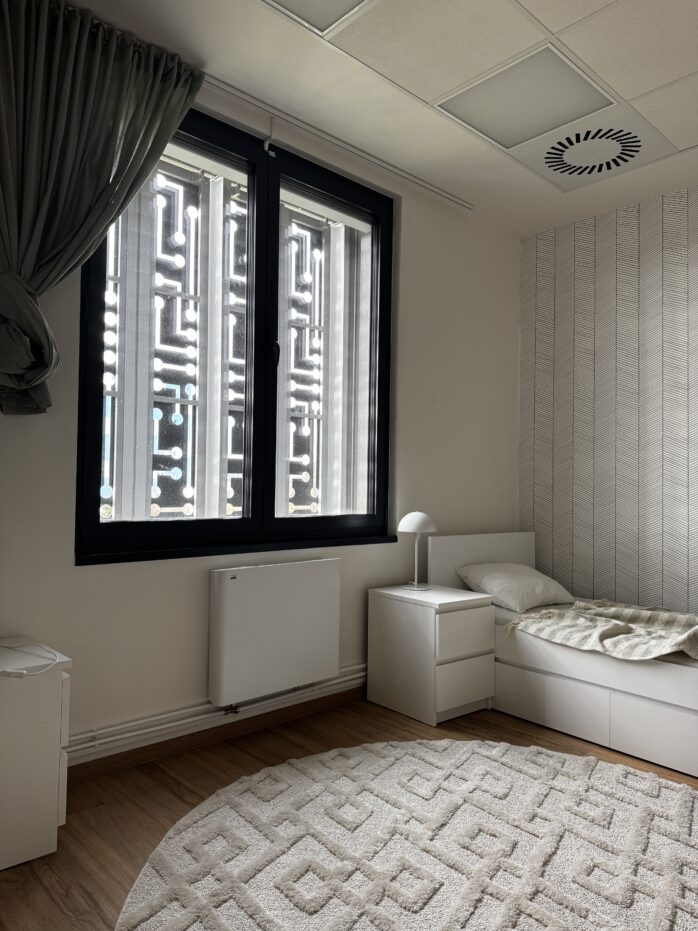
An experimental thermal energy storage unit based on phase change materials (PCM) has been operational throughout the current heating season in the CPIT TL3 building at VSB–Technical University of Ostrava. After months of technical evaluation, the international NewHeatIntegrated project is now moving into the next stage, testing with real occupants.
Unlike conventional hot water tanks, PCM-based storage systems store energy through the phase transition of the material during melting and solidification. This results in more than twice the energy density of water-based tanks of the same volume. A unit roughly the size of a refrigerator can cover an apartment’s entire evening and overnight heating demand using energy accumulated during the day from surplus solar power or off-peak electricity, thereby balancing the electrical grid.
The apartment installation features a thermal energy storage unit that uses Parafol 22-95 paraffin with a melting range of 41–43 °C, configured as a fully autonomous system. To ensure precise results, the building’s standard heating has been disconnected for the duration of the experiment, allowing the PCM system’s performance to be evaluated without external interference. Heat is distributed to the living room and bedroom via low-temperature fan-coil units operating in the 30–40 °C range. The system automatically switches between three modes: charging, discharging, and bivalent operation, where an electric heating element provides backup heat directly to the rooms in case the storage is fully discharged and heating is required. The entire operation is managed by a Siemens LOGO! logic controller, which continuously monitors water flow and pressure, temperatures both inside the tank and in the living spaces, and decides on the current operation mode. All operational data are transmitted to the Amazon AWS cloud platform and visualised for the research team.

Following the successful technical validation during the first half of the heating season, the project has now entered the controlled occupancy phase. A test subject has officially moved into the apartment and is currently simulating everyday life. However, his role goes beyond simply living there. The subject is tasked with intentionally triggering specific events such as opening windows, ventilating rooms, and changing the desired temperature settings, while also keeping a precise log of these actions. We are actively cross-referencing these manual logs with the data collected from the apartment’s sensors and control system to accurately evaluate the heating system’s real-time response. Furthermore, this ongoing phase is realized in close collaboration with the Health Lab at VŠB. While we monitor the building’s infrastructure, the Health Lab team is continuously monitoring the test subject’s vital signs, movement patterns, and overall physiological comfort, giving us a complete picture of the interaction between the smart environment and human health.
The goal of the experiment is to validate the PCM system’s ability to maintain a stable indoor environment and respond flexibly to unpredictable thermal loads caused by human activity. Furthermore, testing this real-world deployment and gathering extensive data from a controlled environment will pave the way for future applications of the technology.