
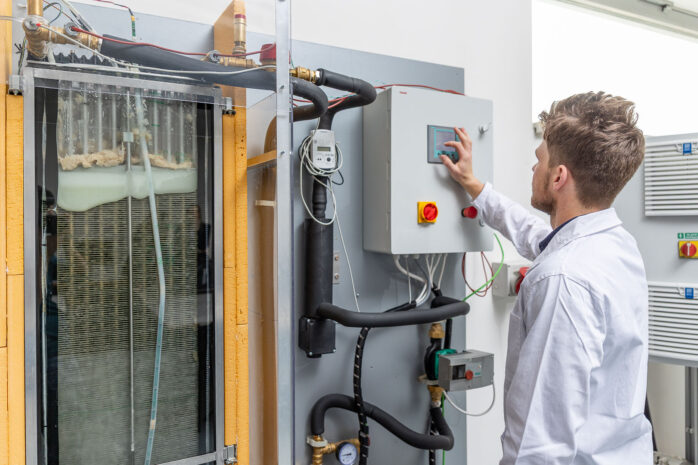
The NewHeatIntegrated research team from the Department of Cybernetics and Biomedical Engineering at VSB-TUO , in collaboration with partners from Fraunhofer ICT , has published a preprint of a new study focused on innovative thermal energy storage systems.
The paper, titled “Experimental evaluation of a modular phase-change material-based thermal energy storage system,” provides a detailed description of the development and testing of a modular unit designed specifically for residential applications.
Key highlights of the study:
- “On-Demand” Energy: The system utilizes 85 kg of sodium acetate trihydrate (SAT) and operates on the principle of controlled supercooling. This allows the stored latent heat to be preserved and released exactly when demand or tariffs justify it.
- Detailed Diagnostics: To accurately measure heat transfer and phase evolution, the prototype features a unique three-dimensional (3D) network of 117 calibrated temperature sensors. This setup enabled the researchers to visualize the process through detailed thermal maps.
- High Stability and Efficiency: Repeated charging and discharging tests confirmed stable operation without phase segregation or material degradation. In a long-duration experiment emulating real-world household use, the overall daily efficiency reached approximately 65%.
- A Pathway to Deployment: The study identifies specific engineering improvements, such as optimized heat exchanger fin spacing and improved insulation, outlining a clear path for deploying these compact systems in real residential energy systems.
This research represents a significant step toward more efficient use of renewable energy sources and the reduction of household energy consumption.
The full preprint of the study is available here: https://ssrn.com/abstract=6313709.
This research was supported by the Technology Agency of the Czech Republic (Project No. TH83030001) under the CETPartnership programme.